The Science of Care
Our operational framework is dedicated to designing safety through ISO 9001 governance and the principles of Implementation Science.
The Governance Hierarchy: In social care, ‘compliance’ is often treated as a box-ticking exercise. At Mutima Care, we approach this as a design challenge.
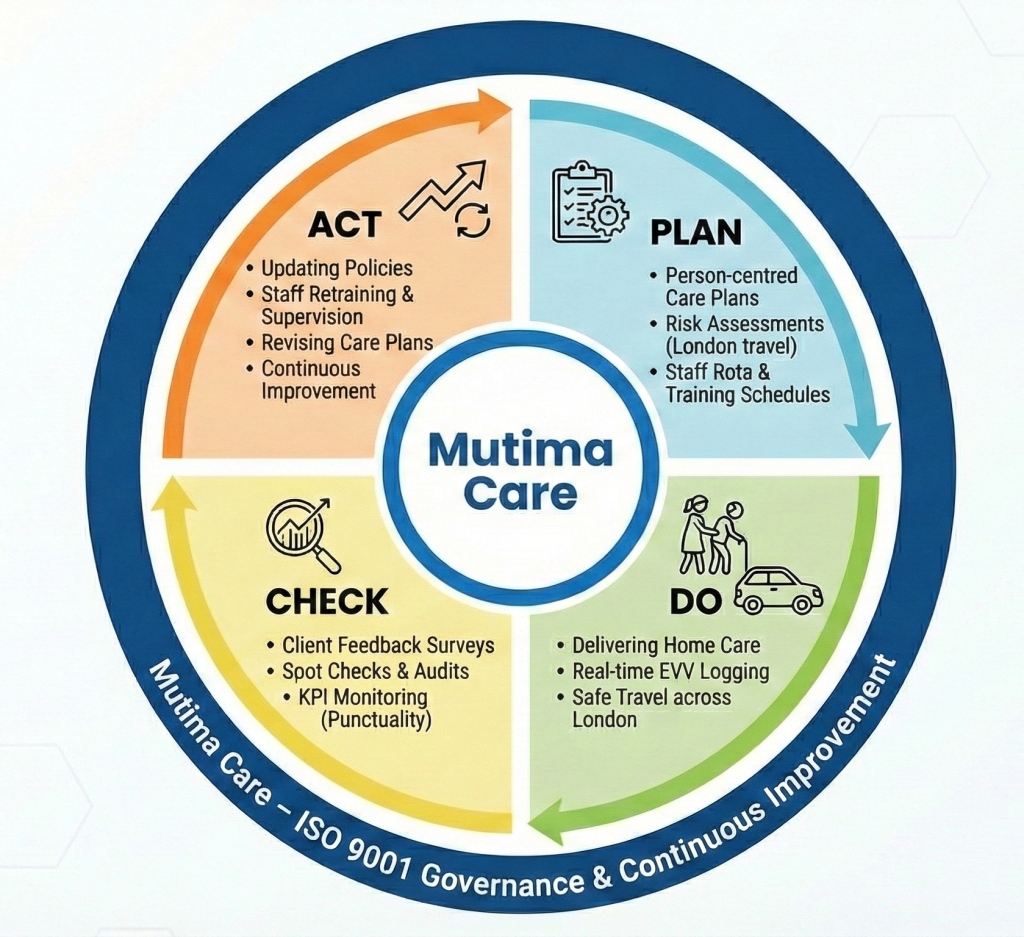
Our proposed operational framework is structured around a unified Quality Management System (QMS) aligned with ISO 9001:2015 standards. While the CQC Single Assessment Framework provides the mandatory legal baseline for safety in England, our internal ISO-aligned framework is designed to provide the design to exceed it.

We do not simply hope for quality; we have planned for it. By applying the ISO principle of the ‘Plan-Do-Check-Act’ cycle, our systems are designed to ensure that CQC standards, from Safe Staffing to Effective Care, will be embedded into the daily pattern of the service upon commencement.
Implementation Science in Action: There is often a critical gap between medical theory (what should happen) and home-based reality (what actually happens). Our leadership approach draws upon Implementation Science, the discipline of closing that gap.
Our intended methodology focuses on translating high-level clinical guidelines (such as NICE protocols for dysphagia or catheter management) into practical, workable workflows. This approach is designed to ensure that ‘Best Practice’ is not just a document sitting on a shelf, but a standard ready to be delivered in the home environment.

The Simulation Standard: Complex care carries inherent risks. To mitigate them, our training policy has been drafted to mandate a standard that goes far beyond online modules.
Our protocols stipulate mandatory Practical Simulation for all high-acuity tasks. We are equipping our training suite with anatomically accurate aids (including NG Tube systems and Catheter sets) to ensure staff can demonstrate mechanical proficiency in a controlled environment.

Continuous Quality Improvement (CQI): A static service is an unsafe service. We have designed a ‘Closed-Loop’ audit strategy intended to catch small errors before they become significant incidents.
Our QMS is configured to trigger scheduled thematic audits on medication records (MAR charts) and daily logs using digital monitoring tools. Protocols require data to be analysed to identify trends. Our ‘Just Culture’ policy dictates that if a process fails, we do not blame the individual; we fix the system through continuous improvement.
This culture of Predictive Assurance is designed to allow us to intervene early, spotting potential dehydration trends or mobility changes to help keep future clients safe at home.